Materials & Microstructure
Phase evolution, microstructure development, and related field-based models provide natural testbeds for structured physics-derived computation.

ARCHEQ is being developed for nonlinear dynamical models across science and engineering, with an initial emphasis on problems whose governing physics can be expressed through structured local interactions.
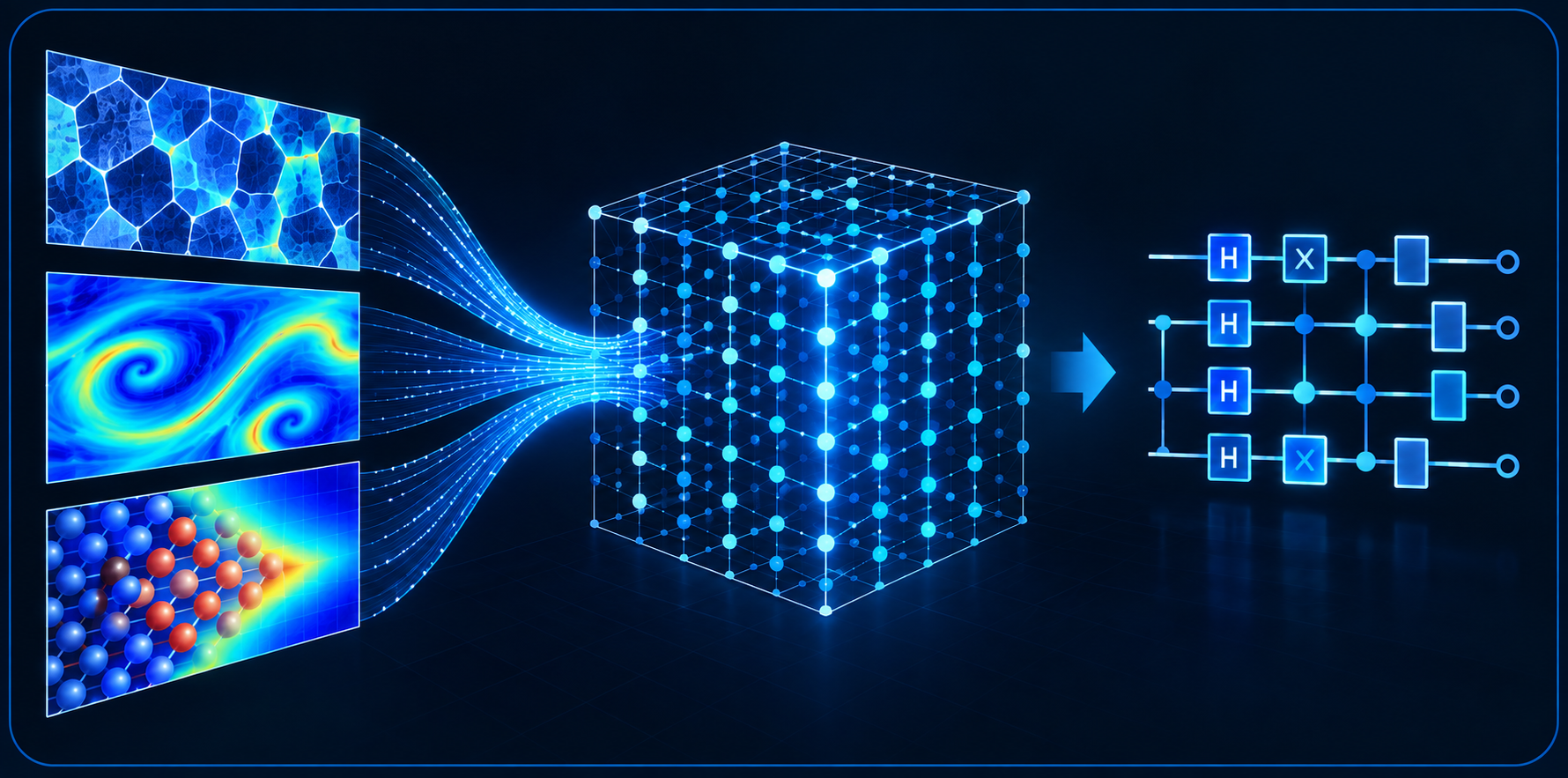
Phase evolution, microstructure development, and related field-based models provide natural testbeds for structured physics-derived computation.
Diffusion and transport equations offer important model classes for developing and validating systematic equation-to-computation workflows.
Coupled reaction and reaction–diffusion systems introduce nonlinear interactions that are central to many scientific and engineering applications.
The longer-term architecture is aimed at increasingly coupled physical systems in which multiple fields and mechanisms interact across a common computational framework.
The goal is a transferable software framework rather than a solver tied to one material system or one PDE family. As the platform develops, ARCHEQ intends to extend the same physics-first principles to broader classes of nonlinear dynamical systems and advanced computing backends.